

Neutral Flux Probe
Institution
Michigan State University
Class
Iron Class (2018 – 2019)
Student Team
Spring 2019
Tony Anason, Mechanical Engineering
Drew Dunker, Mechanical Engineering
Collin Germain, Electrical & Computer Engineering
Zheng Liu, Electrical & Computer Engineering
Giancarlo Martinez, Electrical & Computer Engineering
Paul Schulman, Mechanical Engineering
Jordan Thayer, Mechanical Engineering
Sarah Wegert, Mechanical Engineering
Alek Zultowski, Electrical & Computer Engineering
Fall 2018
Val Gueoguiev, Mechanical Engineering
Cameron Hodgson, Electrical & Computer Engineering
Ivan Gueoguiev Iovtchev, Mechanical Engineering
Suhas Kodali, Mehcanical Engineering
Andrej Serafimovski, Electrical & Computer Engineering
Haochen Sun, Electrical & Computer Engineering
Joey Xie, Mechanical Engineering
Fan Xu, Mechanical Engineering
Scientific & Technical Guidance
Dr. Jason Frieman, NASA Glenn Research Center
Academic Guidance
Dr. John Albrecht, Associate Professor and Associate Chair for Research, MSU Electrical and Computer Engineering
Dr. Sergey Baryshev, Assistant Professor, MSU Electrical and Computer Engineering
Dr. Giles Brereton, Associate Professor, MSU Mechanical Engineering
Dr. Jim Lang,Industrial Liaison for Design Projects, MSU Mechanical Engineering
Project Description
The Psyche spacecraft will utilize an electric propulsion system composed of a set of Hall effect thrusters (HETs) in order to enable the spacecraft to reach the asteroid and maintain each of its science orbits. On the ground, HETs are testing in large vacuum facilities in order to simulate space conditions. However, these facilities are unable to perfectly replicate orbital conditions, resulting in higher background pressures during ground tests relative to what is experienced on-orbit. Several studies have shown that HET performance varies with background pressure due to the interactions between the thruster and residual propellant left in the test facility. In order to better understand this interaction, a diagnostic is needed to detect and track the motion of these residual propellant atoms (i.e., neutrals) in these test facilities, along with a way to move and position that diagnostic.
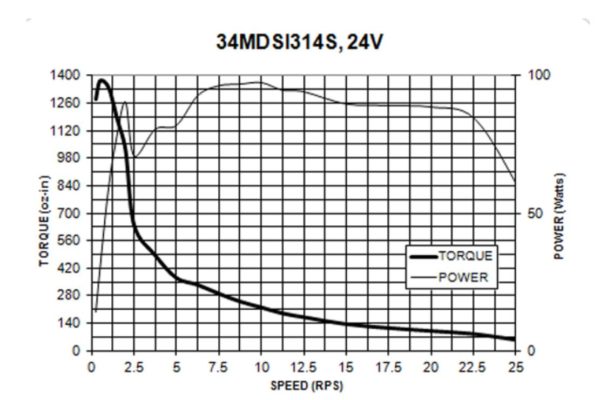
Plot of the Torque curve.

CAD design rendering.
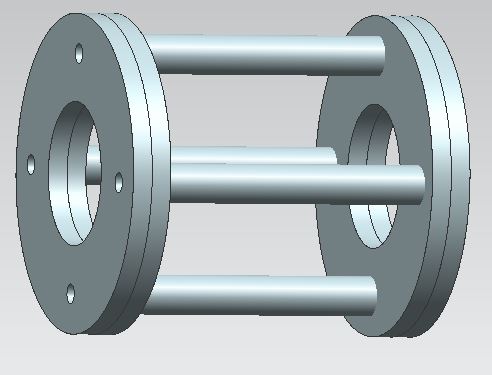
CAD design Rendering.
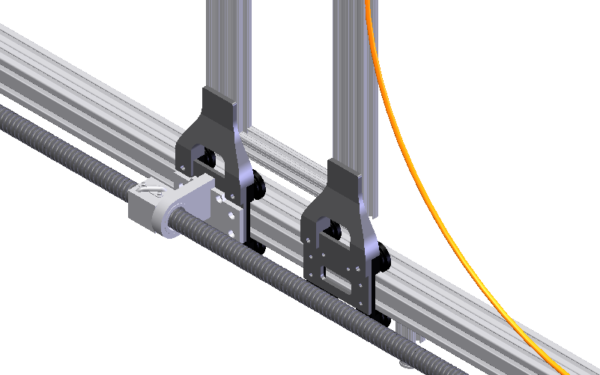
CAD rendering of carriage.
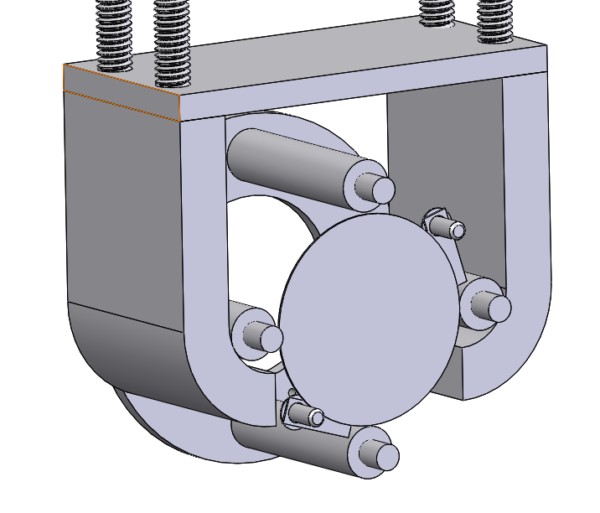
CAD rendering of probe cradle.
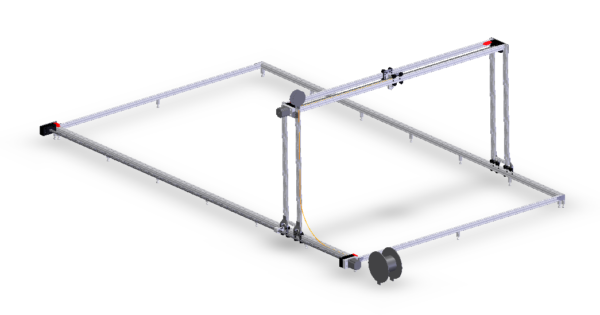
CAD rendering of the traversing mechanism.
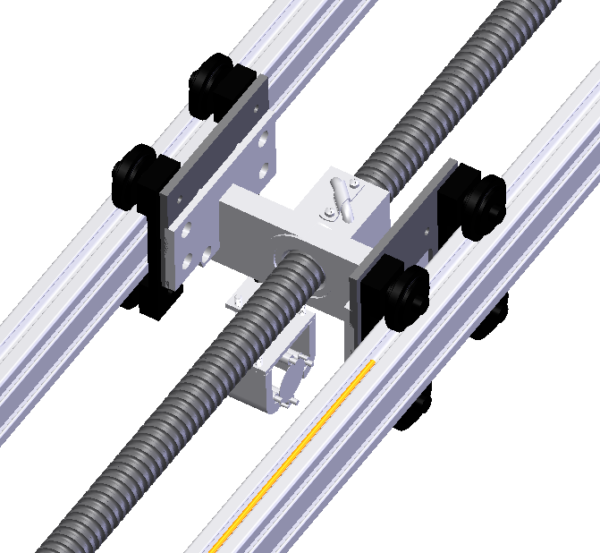
CAD rendering of the y-axis carriage