Hypothesized Surface: ISRU for Hypothesized Surfaces – Arkansas Razornauts

INSTITUTION

University of Arkansas

CLASS

Tungsten Class (2023 – 2024)

STUDENT TEAM

Chris Stites, Mechanical Engineering
Denton McCullough, Mechanical Engineering
Orion Buster, Mechanical Engineering
Richard Lundsgaard III, Mechanical Engineering
Four people in red shirts stand by a table with a rover prototype and display boards, showcasing a resource-collecting project


ACADEMIC GUIDANCE

Mr. Jason Bailey

PROJECT DESCRIPTION

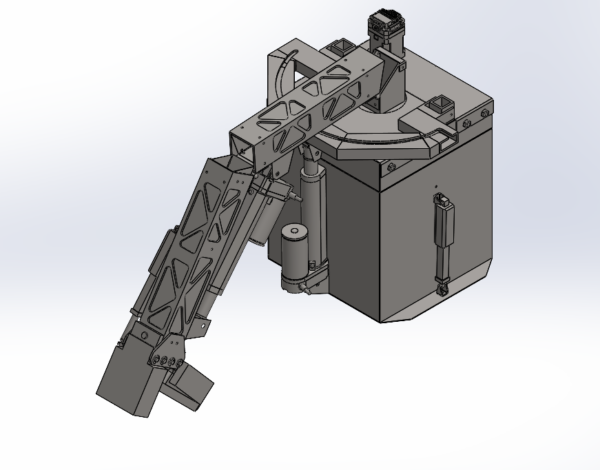
The Arkansas Razornauts are developing a prototype that is meant to be a resource-collecting rover attachment, but could easily be iterated to be a self-propelled digging apparatus. The teams’ prototype specializes in loose aggregate collection in the 0-1 square inch range and prioritizes collection attempts. The prototype is loosely based on an excavator on Earth as it features linear arm movement and a digging field of roughly 160 degrees. However, it differentiates from an excavator because the prototype incorporates a hollow arm that allows sample movement and storage within the body of the prototype.
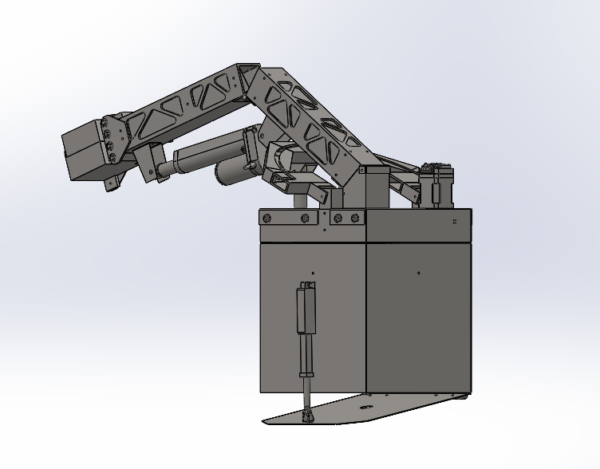
Prototype CAD of a resource-collecting rover attachment with an articulated arm and boxy base structure Prototype CAD of a resource-collecting rover attachment with an articulated arm and mechanical components Prototype of a resource-collecting rover attachment with a mechanical arm and box-like base, designed for surface excavation Prototype CAD of a resource-collecting rover attachment with an articulated arm and digging apparatus CAD model of a resource-collecting rover attachment with an articulated arm and rectangular base, designed for ISRU tasks


Download Bonus Files

This work was created in partial fulfillment of the University of Arkansas Capstone Course “MEEG 4182”. The work is a result of the Psyche Student Collaborations component of NASA’s Psyche Mission (https://psyche.ssl.berkeley.edu). “Psyche: A Journey to a Metal World” [Contract number NNM16AA09C] is part of the NASA Discovery Program mission to solar system targets. Trade names and trademarks of ASU and NASA are used in this work for identification only. Their usage does not constitute an official endorsement, either expressed or implied, by Arizona State University or National Aeronautics and Space Administration. The content is solely the responsibility of the authors and does not necessarily represent the official views of ASU or NASA.